Recently a friend of mine was unhappy with his appraisal as he thinks he deserved more because of good amount of hard work he had put in. Well that probably is a case with most of the employees these days especially in IT companies because of the inflating salaries causing huge expectations.
My suggestion to him was "it could be possible that your boss does not know how exactly you are putting in a lot of effort and you must focus not only on the effort but also on the visualization of that effort to the concerned person(boss)". This in other words means projecting the work done is as important as doing the work.
Here is one good example.
"The Taj Group of Hotels once faced a peculiar business problem. The mirror in the hotels’ bathrooms became misty after a hot shower and people invariably used a towel to wipe off the mist to see their face. So, Taj put a heat source behind the mirrors, which prevented the mist from forming. But when customers were asked what they felt about the change in the mirrors, they hadn’t even noticed it. Then Taj came up with the idea of putting the heat source only on a square portion of the mirrors, which showed the face of people. Mist was allowed to settle on the remaining parts of the mirror. The customers found this really innovative"
Found this example on agencyfaqs as a part of Harish Bijoor article. I think it is an excellent example of what is done may not be noticed as long as it is not planned accordingly. This stands equally true @ work as well.
It is not that your supervisor wants you to chase them all day to serve them in sycophancy but then you are not the only one whom he supervises and just as you don't know what all he does in those 9-12 hours he is at work, he may not know about you either. Though you not knowing enough about his efforts does not matter but vice versa will impact you. So keep this in mind when you go in for an appraisal next time.
Anyways no matter what your supervisor gives you, it will not be sufficient for long enough! isn't it ?
Tuesday, October 30, 2007


Friday, October 26, 2007
Movie insurance
How often does it happen that you start watching a movie and with in the first 15 minutes you realize that it would be a waste of time and stress on your brain? And what if that happens in case you went to watch a movie like that in a cinema hall paying more than Rs. 200 because you were mesmerized by the glitzy promotions.
I think cinema halls should have some kind of an insurance where if you walk out the theater within first 15 minutes then 50% to 75% of the ticket price would be returned.
I think cinema halls should have some kind of an insurance where if you walk out the theater within first 15 minutes then 50% to 75% of the ticket price would be returned.
Tuesday, October 23, 2007
Prohibited or not?

Looking at this I do not understand whether smoking is exactly prohibited or not inside a plane toilet. If smoking is prohibited then why an ashtray next to it. This to me is equivalent to someone saying - murder is a crime but in case you happen to do one please do not let the blood spill here and there. Clean the knife and floor.
Saturday, October 20, 2007
I, We and Leadership
Since more often than not, I do not have much to do so I speak to people around me on leadership etc.
Often my argument is when leaders speak(exclusive of personal interviews) they should prefer to use 'we' over 'I' as much as possible. Because, though it is they who stand on the podium, it is they who will take big decisions, it is they who will sign the deals but to make people feel they are a part of the organisations, leaders must use 'we'.
Last sunday I was travelling from Bangalore to Guwahati. I had to change 2 flights. Would like to share an observation.
Kingfisher airlines. The inflight magazine contains an address from Mr. Vijay Mallya who is currently acting as the Chairman and Chief Executive for the airlines. In his address to the passengers he uses 'I' 4 times and 'we' 2 times.
Spicejet. The inflight magazine contains Mr. Siddhanta Sharma's Address to passengers. Mr. Sharma is the CEO for Spicejet. He uses 'we' 6 times and 'I' only once.
If you were given a choice to work in the team of one of the leaders above which one would you choose?(keeping apart the grand charisma and magnanimous reputation of Mr. Mallya).
Often my argument is when leaders speak(exclusive of personal interviews) they should prefer to use 'we' over 'I' as much as possible. Because, though it is they who stand on the podium, it is they who will take big decisions, it is they who will sign the deals but to make people feel they are a part of the organisations, leaders must use 'we'.
Last sunday I was travelling from Bangalore to Guwahati. I had to change 2 flights. Would like to share an observation.
Kingfisher airlines. The inflight magazine contains an address from Mr. Vijay Mallya who is currently acting as the Chairman and Chief Executive for the airlines. In his address to the passengers he uses 'I' 4 times and 'we' 2 times.
Spicejet. The inflight magazine contains Mr. Siddhanta Sharma's Address to passengers. Mr. Sharma is the CEO for Spicejet. He uses 'we' 6 times and 'I' only once.
If you were given a choice to work in the team of one of the leaders above which one would you choose?(keeping apart the grand charisma and magnanimous reputation of Mr. Mallya).
Friday, October 19, 2007
Durga Pooja
Durga Pooja pictures and videos from Guwahati, Assam. Without the unnecessary chattering of news channels.
Videos are at the bottom(Video quality is not very good though).
Camera : Sont Cybershot DSC T10.


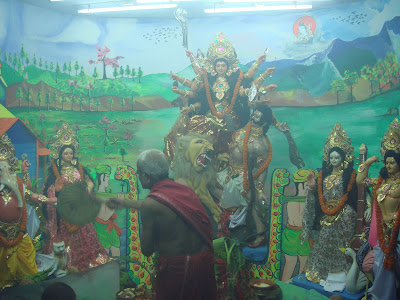

Videos are at the bottom(Video quality is not very good though).
Camera : Sont Cybershot DSC T10.


Thursday, October 18, 2007
Banker to the Poor. Book Review-V
 Authors - Muhammad Yunus, Alan Jolis.
What started as an experiment in 1974 has today become one of the largest institutions in MicroCredit.
Microcredit is a concept that was not accepted easily by any banker in the 70s and the situation has improved only marginally even today, thats what yunus conveying in this book. As the title suggests Grameen is a bank which understands only one thing - Poor.
Some very good points in the book are:
-- The poor knows better how to fend for themselves than the guy sitting inside an airconditioned room in some swanky building.
-- Trust can be more powerful than mortgage.
-- Its good to have contacts in the government and use them appropriately required.
Though it is Yunus' Autobiography and one would expect personal annecdotes in between but there are a number of times when the author deviates too much from the Grameen story.
So read on if topics like poverty, development, society, upliftment etc. interest you.
Sunday, September 30, 2007
Electronic Menus in restaurants-I

You enter a restaurant and take seat. On the table you have a touch screen probably double the size of a PDA(yes, smaller than the one displayed on the left). You open it and see various options available to you.
Food
Drinks
Music
Assuming you choose 'food' and you get options ranging from Chinese, Muglai to Thai and whatever you normally get to see in a restaurant. Just read the customer comments and ratings for each of the delicacies as rated by so many customers who would have tried them, loved them and hated them and you could probably choose from the best rated to weirdly commented.
How about the item you heard from your friend he said tastes good? You might want to check out how have others rated it and what do they say about it. Put it in the search option available to you on the top of your screen(powered by none other than Goggle).
You liked it! But then you like it low salt, low oil, spicy etc. You choose from the options of various degrees for each ingredient of the dish.
You choose your drinks, food and confirm your order. Pops up the screen letting you know the time you will have to wait for that chilled drink to quench your thirst or satiate your palate.
Now when you have had a nice time with your family so you don't call the waiter who could take a few minutes to come over and then do the whole money exchange thing(of course not necessary). Just look at the right side of the menu there is swipe machine integrated in your touch screen. You swipe your card enter the amount of your bill which was displayed as soon as you pressed that red "bill" tab - I know you hate it. Oh you don't use credit cards! Just press the "cash" tab next and that same waiter who served you appears in less than a minute with all the possibilities of the change that he may have to give you back. In the meanwhile you could have added your ratings and comments on what you liked and what you did not.
By the way you like music when you go out for a fine meal, don't you? You could have chosen your pick from the music library that was available to you right from your touch screen.
You just had your fine meal in restaurants that could be the future.
Friday, September 21, 2007
20-50 - Cricket world cup 2015
I always felt 20-20 is not for bowlers. In fact I often used to say that in T20 bowlers could only bleed as the concept of the game was to score irrespective of the pitch, fielding etc.
With India's performance against Pakistan and South Africa where the team defended average scores of less than 150, not only the bowlers have done a commendable job but I also gladly accept my wrong notion of no room for bowling.
But, of course the best thing I have liked in the T20 tournament till now is the short span of the match. 3 hours for a cricket match in my opinion is the best thing to have happened where one can watch the match without having to miss his work, take leave, stay awake the whole night etc.(all so common for Cricket crazy Indian fans).
I think this is how the 2015 Cricket world cup should be.
32 teams to play the world cup.
Round 1 - 8 groups, 4 teams in each group. 20-20 matches intra group.
Top 2 teams from each group to move to next round.
Let us say then we have A1, A2, B1, B2 .... H1 and H2
Round 2 - A1 plays B1 and B2 and so does A2. So 2 teams from one pair play 2 teams of another pair and this round be 20-20 too.
Based on the points and run rates the best 8 out of the 16 move to round 3.
Round 3 - Quarter finals.
and now begins the show down with 50-50 in place.
From here on the tournament goes as any other tournament.
With 32 teams playing cricket I am sure there would be lot more variety than we get to see today and with 20-20 in first 2 rounds it will not last for months. With 50-50 in last 3 rounds the big boys will not be able to complain either about the reduction in the quality of sport.
Of course grooming 32 teams to be able to play up to international standard will have to be ICC's job and I do think 8 years is a good time to bring teams to that level. ICC has much to gain from entry of so many teams into international arena so they should not have any qualms for such a daunting task.
Regardless of my weird ideas till India plays Australia on Saturday we can say - "Bharat desh ka nara hai, 20-20 hamara hai", "Indian's slogan is 20-20 is ours".
With India's performance against Pakistan and South Africa where the team defended average scores of less than 150, not only the bowlers have done a commendable job but I also gladly accept my wrong notion of no room for bowling.
But, of course the best thing I have liked in the T20 tournament till now is the short span of the match. 3 hours for a cricket match in my opinion is the best thing to have happened where one can watch the match without having to miss his work, take leave, stay awake the whole night etc.(all so common for Cricket crazy Indian fans).
I think this is how the 2015 Cricket world cup should be.
32 teams to play the world cup.
Round 1 - 8 groups, 4 teams in each group. 20-20 matches intra group.
Top 2 teams from each group to move to next round.
Let us say then we have A1, A2, B1, B2 .... H1 and H2
Round 2 - A1 plays B1 and B2 and so does A2. So 2 teams from one pair play 2 teams of another pair and this round be 20-20 too.
Based on the points and run rates the best 8 out of the 16 move to round 3.
Round 3 - Quarter finals.
and now begins the show down with 50-50 in place.
From here on the tournament goes as any other tournament.
With 32 teams playing cricket I am sure there would be lot more variety than we get to see today and with 20-20 in first 2 rounds it will not last for months. With 50-50 in last 3 rounds the big boys will not be able to complain either about the reduction in the quality of sport.
Of course grooming 32 teams to be able to play up to international standard will have to be ICC's job and I do think 8 years is a good time to bring teams to that level. ICC has much to gain from entry of so many teams into international arena so they should not have any qualms for such a daunting task.
Regardless of my weird ideas till India plays Australia on Saturday we can say - "Bharat desh ka nara hai, 20-20 hamara hai", "Indian's slogan is 20-20 is ours".
Wednesday, September 19, 2007
Sachin
Sachin's last play in England. A good slide show I found on The First Post.
This is not the first of its kind slide show especially for a legend like Sachin. But, since I admire him and I found it today by chance so thought of linking it here. I admire him because:
> His bat spoke for him and not he.
> He never answered criticism to defend himself. He knew what he was doing and what he had to do.
> He always made a comeback in the worst of times.
> His behavior was always of a gentleman.
Ok, since I am sounding very cliched here so I will stop before the fewest of the reader's of my blog pledge to stop reading my blog.
But like Ashoka, Budha, Ram, Krishna, Prophet and Jesus became history. He would become history too. A history that will be remembered till when cricket will not cease to exist.
This is not the first of its kind slide show especially for a legend like Sachin. But, since I admire him and I found it today by chance so thought of linking it here. I admire him because:
> His bat spoke for him and not he.
> He never answered criticism to defend himself. He knew what he was doing and what he had to do.
> He always made a comeback in the worst of times.
> His behavior was always of a gentleman.
Ok, since I am sounding very cliched here so I will stop before the fewest of the reader's of my blog pledge to stop reading my blog.
But like Ashoka, Budha, Ram, Krishna, Prophet and Jesus became history. He would become history too. A history that will be remembered till when cricket will not cease to exist.
Tuesday, September 18, 2007
Suggesting or insisting
On the FC Blogs, after reading Innovation: Lessons From a Car Shopping Experience, I had made a long comment. Longer than some of my own blog posts, so I thought of posting the same comment here too.
My comment was "Pushing a customer to alternatives of the product which the customer is looking for is definitely not going to help. In fact it will have a negative impact even if the dealer is suggesting a superior product at whatever price.
But, I think there is a finer line between insisting and suggesting. Suggesting is not a bad thing if properly dealt with.
In today's world with internet though most of the customers come with as much knowledge of the car as the sales representative at the dealer, still there are customer's who are not exactly sure what they are looking for. They have plain aspirations and that is where suggestive approach can help.
Again there has to be a strong restrain from making that suggestive approach into an insistence.
In this case you as a customer had very clear priorities and understanding, where the best a dealer could have done was answer all your questions and be obliged to meet your requests.
But, an attitude of suggesting superior product, lower prices, alternatives should have been the approach only after understanding what the customer is looking for i.e. after getting to understand a little more about the customer."
My comment was "Pushing a customer to alternatives of the product which the customer is looking for is definitely not going to help. In fact it will have a negative impact even if the dealer is suggesting a superior product at whatever price.
But, I think there is a finer line between insisting and suggesting. Suggesting is not a bad thing if properly dealt with.
In today's world with internet though most of the customers come with as much knowledge of the car as the sales representative at the dealer, still there are customer's who are not exactly sure what they are looking for. They have plain aspirations and that is where suggestive approach can help.
Again there has to be a strong restrain from making that suggestive approach into an insistence.
In this case you as a customer had very clear priorities and understanding, where the best a dealer could have done was answer all your questions and be obliged to meet your requests.
But, an attitude of suggesting superior product, lower prices, alternatives should have been the approach only after understanding what the customer is looking for i.e. after getting to understand a little more about the customer."
Subscribe to:
Posts (Atom)